History of Solar Energy
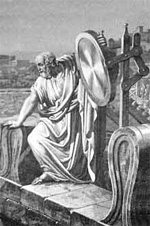 Solar power technology isn’t new. Its history spans all the way back to the 7th century B.C., when a magnifying glass was used to concentrate sun’s rays to make fire. In the 3rd century B.C., Greeks and Romans used burning mirrors to light religious torches, and in the 2nd century B.C., a Greek scientist, Archimedes, used highly reflective bronze shields to focus sunlight and to set fire to wooden ships from the Roman Empire which were besieging Syracuse. Closer to the present, in Rome during the 6th century A.D., people were commonly building sunrooms on houses and public buildings, and they thought so much of their sunlight that “sun rights” were protected under the Justinian Code to ensure individuals’ access to the sun. During the 1200s the North American ancestors of Pueblo people called Anasazi built their cliff dwellings to capture the winter sun for warmth.
The world’s first solar collector was created by a Swiss scientist named Horace de Saussure. This solar collector was later used by Sir John Herschel to cook food during his 1930s expedition to South Africa. On September 27, 1816, a man named Robert Stirling applied for a patent for his economiser at the Chancery in Edinburgh, Scotland. Lord Kelvin used one of the working models during some of his university classes. This engine was later used in the dish/Stirling system, a solar thermal electric technology that concentrates the sun’s thermal energy in order to produce power.
Then in 1839, a French scientist named Edmond Becquerel discovered electricity-generation while experimenting with the the photovoltaic effect using an electrolytic cell made up of two metal electrodes, immersed in an electricity-conducting solution that increased electricity production when exposed to light. The next step was in 1873 when Willoughby Smith discovered that selenium possessed photoconductivity. Quickly following this in 1876 William Grylls Adams and Richard Evans Day discover that selenium produces electricity when exposed to light. Although they failed to actually power electrical equipment, this did prove that a solid material could change light into energy.
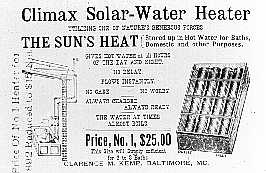 In 1891, Baltimore inventor Clarence Kemp patented the first commercial solar water heater. During the early 1900s, scientists continued to find other photosensitive materials such as copper and cuprous oxide, copper coils, and finally single-crystal silicon in 1918 by a Polish scientist, Jan Czochralski. In 1921 Albert Einsein gives his nod to solar energy and wins the Nobel Prize for his theories explaining the photoelectric effect.
 In 1931, an article by Modern Mechanix magazine claiming a new Sun Furnace had enough power to vaporize diamonds: A HEAT of 4500 degrees centigrade, intense enough to turn a diamond into vapor and to melt any known substance, is expected to be generated in an amazing new solar furnace which derives its heat directly from the sun. Eighty per cent of the sun’s heat is expected to be captured by the furnace, which has been designed by scientists of the California Institute of Technology in Pasadena. It consists of a mounting similar to that of a telescope which always follows the sun, upon which are 19 lenses which focus the sun’s rays on a central spot within the apparatus.
 In 1935 an article was published by Modern Mechanix magazine promoting a solar-powered refrigerator – stating: A REFRIGERATOR which requires no energy other than exposure to sunlight for two hours a day has been developed by Otto H. Mohr, California consulting engineer. Larger solar power units requiring up to four hours exposure can be used for heating or cooling entire homes, according to the inventor. A spherical lens catches the sun’s rays at all hours of the day. This lens gathers the rays, and changes the light into heat which is transferred to the refrigerating liquid, usually ammonia. The cooling operation is similar to that of ordinary gas refrigerators.
I’m not sure what happened to that idea – we don’t see these at appliance stores today! Of course, one small problem I see with the design – we don’t keep our refrigerators outdoors in the sun.
Due to the energy scarcity during WWII in the 1940s, passive solar buildings become popular in the United States. A book was even published on the subject, titled Your Solar House, and featured 49 of the nation’s finest solar architects.
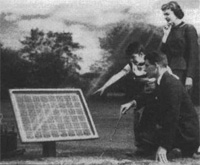 In 1954, Photovoltaic technology is discovered when American Bell Labs scientists develop the silicon photovoltaic (PV) cell — the first solar cell capable of charging and running everyday electrical equipment. The solar cell had just 4% efficiency. At this time, solar panels were not commercially available, and were very expensive. In 1955, Western Electric gets in the market by selling licenses for PV (photovoltaic) technology, and products start to hit the market such as PV-powered dollar bill changers. Continuing in the 1950s architects start using solar water heating, and solar heated buildings and satellites, while continuing to increase efficiency and radiation resistancy of photovoltaic cells.
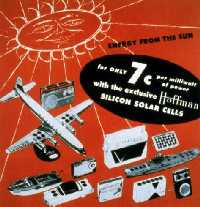 During the first years after the discovery of the silicon solar cell, the cost of solar cells was prohibitive. Desperate to find commercial outlets for solar cells, novelty items such as toys and radios run by solar cells were manufactured and sold.
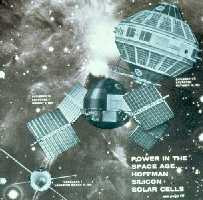 The “Space Race” provided some funding for solar research and development. In 1964, NASA launched the first Nimbus spacecraft, powered by a 470-watt PV array. The new technology to power these spacecrafts were, expensive, some of NASA’s early panels were over $30,000 per watt.
The 1970s were the dawn of commericially affordable solar power. Exxon and Dr. Elliot Berman design a cheaper solar cell, bringing the price from $100 a watt to $20 a watt – making solar cells much more affordable to the masses. Railroads, lighthouses, gas and oil rigs, warning lights and other remote area applications began to use solar cells for power.
 In 1978, the world’s first solar-powered calculators came to the market, allowing everyone to own a solar charged electronic product. The first solar powered calculators introduced included the Royal Solar 1, Teal Photon, and Sharp EL-8028. This Japanese Teal Photon calculator on the left, featured automatic on/off (no switch) and a liquid crystal display with a yellow filter over it to prevent damaging ultra-violet radiation from reaching the liquid crystal. In July 1978, the journal New Scientist reported “The concerned environmentalist can now calculate the downfall of society without eating into the world’s resources in the process. A new calculator that is coming on to the market in the United States does not have an on/off switch – it doesn’t need an on/off switch because the power comes from a small panel of solar cells. The cells’ output is such that if there is enough light around for the user to see the calculator there is probably enough light to power it”. It is amazing that 30 years ago the first solar powered products (calculators) were beginning to be commonly used by the public.
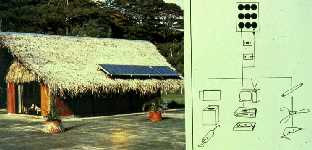 In the 1980s solar power worldwide production increases from 1 megawatt to over 20 megawatts, and efficiency increases to 20% in 1985 at the University of South Wales. In 1986, along with hairspray, faded jeans and neons, the world’s largest solar thermal facility was built in Kramer Junction, California. In 1991, President George Bush changes the U.S. Department of Energy’s Solar Energy Research Institute to the National Renewable Energy Laboratory (NREL), which in turn constructs an energy-efficient “Solar Energy Research Facility” using a solar electric system and passive solar design.
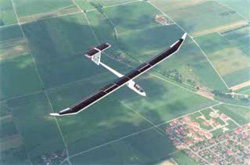 In 1994, NREL develops a solar cell that exceeds 30% efficiency. In 1996, the Icare, an airplane covered with 3,000 super-efficient solar cells, flies over Germany. In 1998, Subhendu Guha, a noted scientist for his pioneering work in amorphous silicon, led the invention of flexible solar shingles.
In Ohio in the year 2000, First Solar begins production at the world’s largest photovoltaic manufacturing plant producing enough solar panels each year to generate 100 megawatts of power. Home Depot begins selling residential solar power systems in their stores.
|
Charge your cell phone,
|
Continuing in the 2000s to the present, companies continue to decrease the cost of solar panels, while increasing efficiency. In 2002, Japan installed 25,000 solar rooftops.
In 2006, the U.S. Department of Energy funded the production of a concentrator solar cell by Boeing-Spectrolab which achieved a world-record conversion efficiency of 40.7 percent, establishing a new milestone. At 40% efficiency, the land area needed to supply the entire world of it’s energy needs would be roughly 265 square miles – and considering Colorado alone is 104,100 square miles in size – that isn’t that large an area. Just supplying the USA would take about 25% of that land area. Amazing. Now, with Obama’s energy plan that calls for 10% of the United States electricity to come from renewable sources by 2012, and 25% by 2025, the future is very bright for solar energy.
Now time will tell. As the cost of solar cells decreases and efficiency increases, we are nearing a point in which solar energy costs will equal that of coal, oil and gas – and will likely revolutionize our energy industry. Can’t wait – blue skies ahead!
If you’re interested in learning more about solar energy, or finding solar installers in Colorado, check out the new website I designed for CoSEIA – Colorado Solar Energy Industries Association, you can search for companies that install solar in your neighborhood, and also learn about the differences between Solar electric / photovoltaics and Solar hot water systems. The website also has the latest information on Solar Rebates and Legislation.

Sources:
www1.eere.energy.gov
www.norcalblogs.com
www.solarenergygreenlifestyleforyou.com
What do you think?